Currently Empty: R0.00

How to Choose the Right Water Filter Cartridge for Your Water System
Choosing the correct water filter cartridge is one of the most important decisions when maintaining a reliable water filtration system. The right cartridge can improve water taste, protect equipment, remove unwanted particles, and extend the lifespan of your filtration components.
However, not all water filter cartridges perform the same function. A sediment cartridge designed to remove dirt and sand will not remove chlorine, odours, or organic compounds. Likewise, a carbon cartridge cannot replace a fine filtration cartridge when dealing with suspended particles.
Understanding the different types of filter cartridges, micron ratings, and applications will help you select the best option for your home, business, or industrial water treatment system.
What Is a Water Filter Cartridge?
A water filter cartridge is a replaceable filtration component installed inside a filter housing. As water passes through the cartridge, unwanted substances are trapped or absorbed, improving the quality of the water.
Filter cartridges are commonly used in:
- Household water filtration systems
- Commercial water filtration systems
- Water shops
- Reverse osmosis systems
- Industrial water treatment plants
- Borehole water treatment systems
Different cartridges are designed to target different water quality problems.
Understanding the Different Types of Water Filter Cartridges
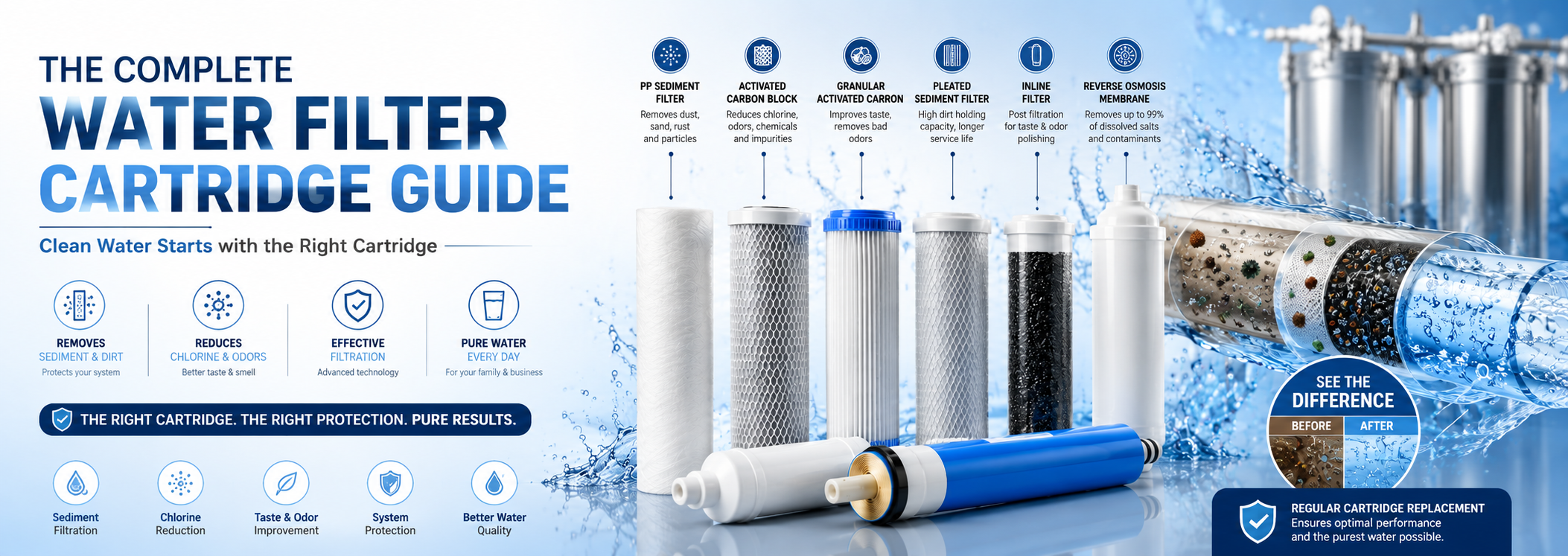
1. Sediment Filter Cartridges
Sediment cartridges are designed to remove physical particles from water.
They commonly remove:
- Sand
- Dirt
- Rust particles
- Mud
- Silt
- Suspended solids
Sediment filters are often installed as the first stage of a filtration system because they protect other components from clogging.
For example, in a reverse osmosis system, a sediment filter protects the RO membrane by preventing larger particles from reaching it.
Common sediment cartridge materials include:
Polypropylene (PP) Spun Filters
PP spun cartridges are made from layers of polypropylene fibres that trap particles throughout the depth of the filter.
Advantages:
- Affordable
- Chemical-resistant
- Suitable for drinking water applications
- Available in different micron ratings
Pleated Sediment Filters
Pleated filters have a larger surface area compared to standard spun cartridges.
Advantages:
- Longer service life
- Higher dirt-holding capacity
- Lower pressure loss
They are useful in applications where water contains higher levels of sediment.
2. Activated Carbon Filter Cartridges
Carbon filters work differently from sediment filters. Instead of trapping particles, activated carbon uses adsorption to capture certain chemicals and impurities.
Carbon cartridges help reduce the following:
- Chlorine taste and smell
- Organic compounds
- Unpleasant odours
- Some chemical contaminants
They are commonly used in drinking water filtration systems.
Types of Carbon Filters
Granular Activated Carbon (GAC)
GAC cartridges contain loose activated carbon granules.
They provide excellent contact time between water and carbon.
Common uses:
- Taste improvement
- Chlorine reduction
- Odour removal
Carbon Block (CTO) Filters
Carbon block cartridges are made by compressing activated carbon into a solid block.
They provide:
- Better filtration efficiency
- Fine particle reduction
- Improved chlorine removal
CTO stands for:
- Chlorine reduction
- Taste improvement
- Odour reduction
3. Specialised Filter Cartridges
Some applications require specialised filtration.
Examples include:
Iron Removal Cartridges
Used where water contains elevated iron levels that cause the following:
- Metallic taste
- Orange staining
- Discolouration
Scale Reduction Cartridges
Designed to help reduce mineral scaling caused by hard water.
Common applications:
- Coffee machines
- Boilers
- Commercial kitchens
Ultrafiltration (UF) Membranes
UF cartridges use very fine membrane technology to reduce:
- Suspended solids
- Fine particles
- Certain microorganisms
They are commonly used where very high-quality filtered water is required.
Understanding Micron Ratings
One of the most important factors when choosing a water filter cartridge is the micron rating.
A micron is a measurement of particle size.
1 micron equals one-millionth of a metre.
The smaller the micron rating, the smaller the particles the filter can capture.
Common micron ratings include:
50 Micron
Used for:
- Sand removal
- Large sediment particles
- Pre-filtration
20 Micron
Used for:
- General sediment filtration
- Residential applications
5 Micron
One of the most common ratings.
Used for:
- Drinking water systems
- RO pre-filtration
- Fine sediment removal
1 Micron
Used where finer filtration is required.
Applications:
- High-quality drinking water
- Sensitive equipment protection
Nominal vs Absolute Micron Rating
Not all micron ratings mean the same thing.
Nominal Micron Rating
A nominal rating indicates the average size of particles removed.
Example:
A 5-micron nominal filter may remove most particles around 5 microns.
Absolute Micron Rating
An absolute rating indicates the maximum particle size that can pass through the filter.
Absolute-rated filters provide more precise filtration.
How Do You Know When to Replace a Filter Cartridge?
Replacing cartridges at the correct time ensures your system continues working effectively.
Signs that a cartridge needs replacement include:
- Reduced water pressure
- Slower water flow
- Change in taste
- Unpleasant odours
- Visible dirt accumulation
- Increased system pressure
Replacement frequency depends on the following:
- Water quality
- Amount of water used
- Type of cartridge
- Application
A household system may require replacement every few months, while industrial systems may require scheduled maintenance based on water testing results.
Choosing the Right Cartridge for Your Water
The correct cartridge depends on your water source and treatment goal.
Municipal Water
Common concerns:
- Chlorine taste
- Sediment
- Pipe particles
Recommended filtration:
- Sediment filter
- Activated carbon filter
Borehole Water
Common concerns:
- Sand
- Iron
- Hardness
- Minerals
Recommended filtration:
- Sediment filtration
- Iron removal
- Carbon filtration
- Additional treatment depending on water analysis
Commercial and Industrial Applications
Businesses may require the following:
- Higher flow cartridges
- Larger filter housings
- Multiple filtration stages
- Custom treatment solutions
A proper water analysis is recommended before selecting equipment.
Why Choosing the Correct Filter Cartridge Matters
Using the wrong cartridge can result in:
- Poor water quality
- Frequent replacements
- Reduced equipment lifespan
- Increased operating costs
A correctly selected cartridge improves filtration performance and protects your entire water treatment system.
Frequently Asked Questions
Are all water filter cartridges the same?
No. Different cartridges are designed for different contaminants. Sediment filters remove particles, while carbon filters improve taste and reduce chlorine.
Is a smaller micron filter always better?
Not always. A very fine filter may reduce water flow and clog faster if installed without proper pre-filtration.
How often should I replace my water filter cartridge?
Replacement depends on water quality, usage, and cartridge type. Regular inspection and water testing provide the best guidance.
Can one filter cartridge remove everything from water?
No single cartridge removes all contaminants. Effective filtration usually requires multiple treatment stages.
Conclusion
Choosing the right water filter cartridge starts with understanding your water quality and knowing what you want to remove. Whether you need sediment removal, better taste, chlorine reduction, or protection for advanced filtration equipment, selecting the correct cartridge ensures better performance and longer system life.
At Puritech, we help customers select suitable filtration solutions for residential, commercial, and industrial water treatment applications.